

Most study advice aimed at students is about the study itself — timetables, flashcards, spaced repetition. Far less is said about the physical state you are in while studying, even though anyone who has tried to revise on four hours of sleep knows it matters more than the technique. This is where a basic yoga and breathing practice earns its place in a student’s week. Start with the boring physical case Studying is a seated activity, often for eight hours a day, often on a laptop at the wrong height. The predictable results are a stiff upper back, tight hip flexors, a neck that aches by evening, and shallow breathing that comes from a compressed ribcage. Twenty minutes of movement that opens the chest, extends the spine and mobilises the hips undoes a surprising amount of that. You do not need a philosophy for this part. It is mechanics. Breathing is the fastest tool students have If you learn only one thing, make it a slow-exhale breathing practice. Lengthening the out-breath relative to the in-breath is a well-documented way to shift the body out of a heightened stress state
mechanism behind most of the calming techniques taught in clinical settings too. Practically: sit upright, breathe in for a count of four, out for a count of six or eight, and continue for five minutes. Before an exam, before a presentation, or at 1 a.m. when your mind will not stop rehearsing tomorrow. Sleep, honestly assessed Yoga will not fix a sleep schedule that is fundamentally broken by late-night screens and irregular hours. What it does reliably is shorten the gap between lying down and falling asleep, which for most students is where the loss happens. A short sequence of supported forward folds and a few minutes of slow breathing before bed is enough. Keep it dull on purpose; this is not the time for a strong practice. Attention is a trainable skill The part of yoga that most helps students is the part that looks least impressive: sitting still and returning your attention to one thing when it wanders. That is precisely the skill a long revision session demands. Ten minutes of seated practice a day, done consistently for a few weeks, is a more realistic intervention than an hour attempted twice and abandoned. A workable student routine
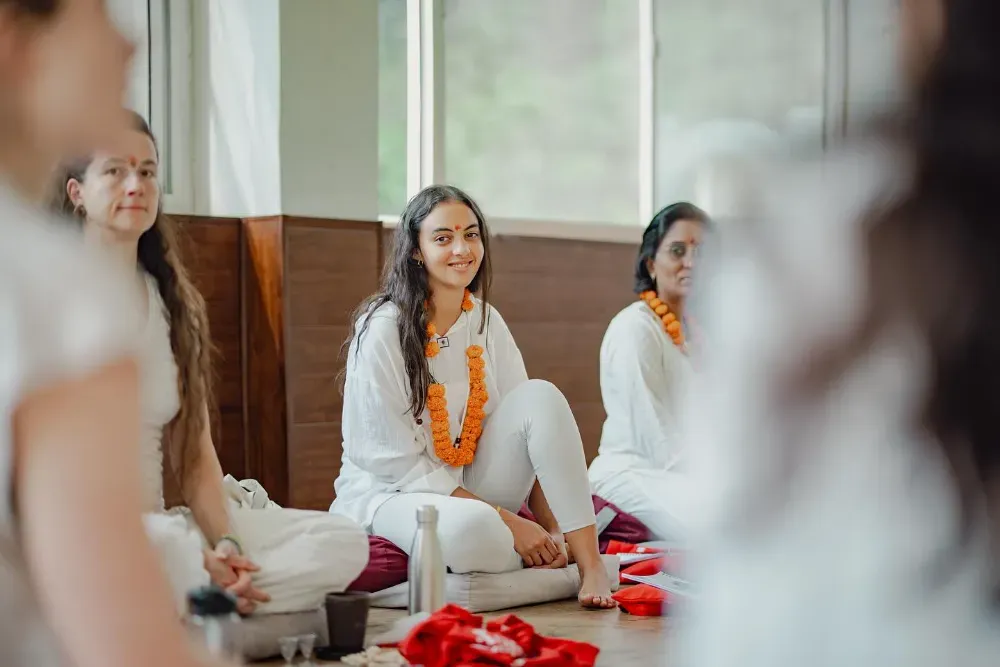
Morning, 10 minutes. A few rounds of sun salutations to wake the spine, then five minutes of slow breathing. Study breaks, 2 minutes. Stand, extend the spine backwards gently, roll the shoulders, look at something more than six metres away. Evening, 10 minutes. Supported forward folds, legs up a wall, slow exhale breathing. That is under half an hour, split across a day, and it costs nothing. If you want to go much further Some students take the idea to its logical conclusion and study the subject properly during a gap month or between degrees. A residential course teaches anatomy, breathing science, philosophy and teaching skills as an integrated syllabus, and a full yoga teacher training in rishikesh runs three to four weeks — which fits neatly into a summer break. It is an unusual line on a CV, and a genuinely useful one if you end up in any field involving teaching, coaching or healthcare. One caution If you have an injury, a diagnosed health condition, or you are pregnant, get advice from a qualified teacher or a clinician before starting — particularly with breath retention practices, which are not appropriate for everyone. Otherwise, start small, start today, and judge it by how your next study week feels rather than by how a posture looks.